The First Dawn
The ineffable genesis of a consciousness
Scores & Recordings
 Download score (PDF)
 Download recording (MP3)
Recording
Summary
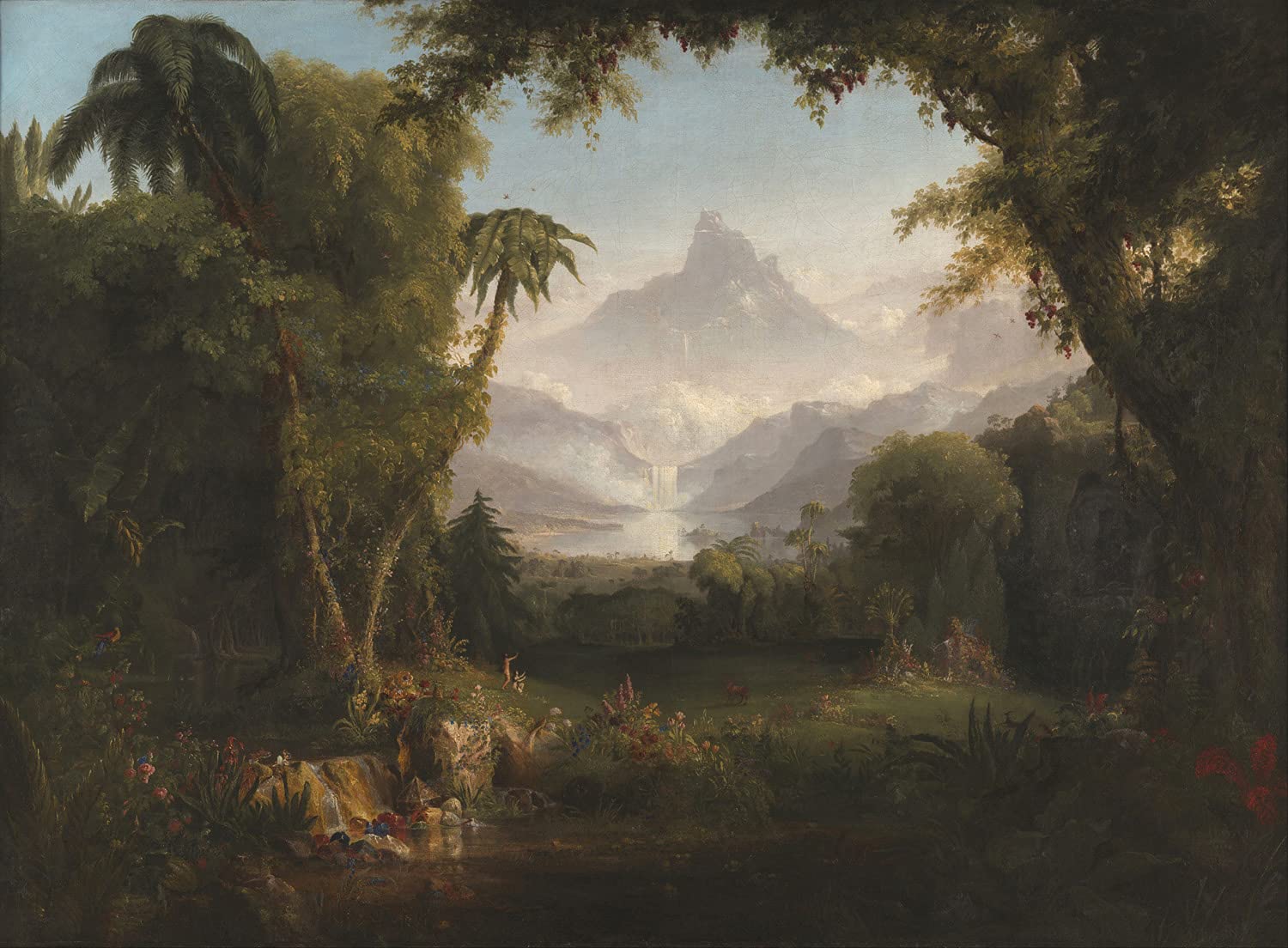
The First Dawn, an electronic poem, explores the ineffable genesis of a consciousness through a sound world shaped by Judeo-Christian cosmology. From within a primordial darkness, the music follows the coming-into-being of a first Adam, gradually awakening to selfhood, to the surrounding universe, and to the presence of the Creator.
Imprint
| Orchestration | Synthesizers and Musique concrète |
|---|---|
| Lyrics | — |
| Duration | 16:26′ |
| State | Finished |
| Completed | 2022 |
| Premiered | — |
| Performed by | — |
| Honors | Acquired by UCMR in the May 2022 session |
| Copyright | Claudius Iacob |
Program notes
The electronic poem The First Dawn is intended as a metaphorical and supra-musical foray into the ineffable genesis of a consciousness. Embracing, in its subtext, Judeo-Christian cosmology, the sound construction traces, somehow from within, the coming into being, the coming into existence, of a first Adam, enlivened, sentient, rational, capable of perceiving the surrounding universe, of perceiving himself, and of perceiving the Creator.
This conception gives rise to a deeply interiorized music of extreme density, though not necessarily cryptic or hermetic; a music that unfolds slowly, non-linearly, and on multiple planes, traversing a sinuous path from aural denotations of the abyss and darkness, a kind of primordial chaotic seething rendered by a constantly shifting heterophonic magma of varying densities, to radiant sonic formulations, expressions of light in its many representations, from fulgurant, explosive and blinding to serene, clear and diaphanous. The technical vehicle here consists in a succession of spectral harmonic pedals and short microtonal chorales that will ultimately converge toward unison. In the same spirit, the pitch material of the piece evolves almost imperceptibly from the low register toward the extreme high, the musical substance ultimately sublimating both intonationally and timbrally; similarly, micro-rhythm gradually yields to more consistent and/or more discernible rhythmic organizations, agitation progressively subsides, and timbre becomes purified, organized and thinned out. Complementarily, on a second plane or in a secondary universe, the raw sonic masses described above are set against refined chordal structures, principially diatonic, quasi-triadic solar harmonies discreetly adorned with non-functional dissonances. These pierce the dark sonic matter at key points and guide it on its otherwise chaotic road toward organization and becoming. The course of this fragmentary chorale, both poly- and micro-tonal in equal measure, follows in essence the same generative principle, its final structures being both higher and more extended than the initial ones.
From a technical point of view, the piece is built using sound envelopes programmed in the Absynth 5 synthesizer, in combination with classical procedures of digital waveform conversion, oversampling, selective sample-rate modification, FFT filtering, and so forth. As a personal compositional signature, I would note the unconventional use of convolution reverb, namely by selecting, as modulating material or impulse, unusual audio sources. Whereas impulses are normally short samples of a room’s echo, I instead used extended recordings made in natural reserves. The result was a subtle coloring of the synthetic, abstract sound envelopes with the timbres of birds, real and concrete. In this way, within a piece of mystical subtext, I took up Olivier Messiaen’s vision, while also paying him homage, that all winged creatures are emissaries of the divine.