Hortus conclusus
Imaginary sacred garden transcending earthly misery
Scores & Recordings
 Download score (PDF)
 Download recording (MP3)
Recording
Summary
Hortus conclusus extends the sacred symbolism of the enclosed garden into a meditation on the conflict between ideal form and fallen material reality. Moving through lush heterophony, birdlike agitation, and chorale-like moments of suspension, the piece imagines a personal sanctuary of light and transcendence within a desacralized world.
Imprint
| Orchestration | chamber orchestra |
|---|---|
| Lyrics | — |
| Duration | 13:23′ |
| State | Finished |
| Completed | 2024 |
| Premiered | — |
| Performed by | — |
| Honors | Acquired by UCMR in the May 2024 session |
| Copyright | Claudius Iacob |
Program notes
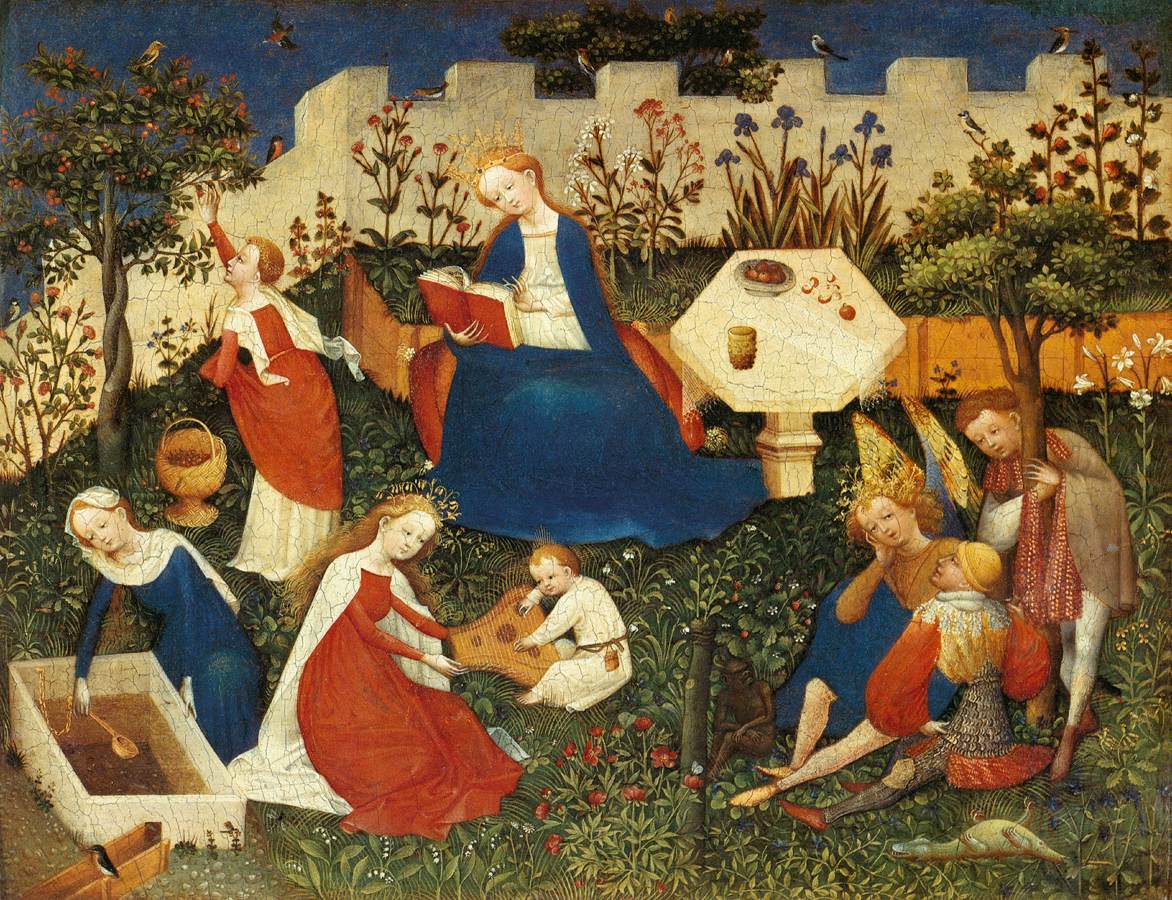
Hortus conclusus, literally Enclosed Garden, or inward, hidden garden, is a widely used Western European cultural reference from the late Middle Ages onward, reaching its apotheosis in the Renaissance, when it became, in the Christian West, the symbolic representation par excellence of the Virgin Mary, especially in connection with the Catholic doctrine of the Immaculata conceptio, a doctrine not shared in the East.
My piece preserves the intrinsic and inextricable aura of sacredness and transcendence that the term acquired in the Renaissance, yet broadens its conceptual frame. In Hortus conclusus, I begin by exploring the fundamental conflict between the ideal, romanticized, idyllic image of the concept of a garden and its tangible, material, worldly realization, full of all the shortcomings, discomforts, and ultimately the miseries inherent to biological life. Once there, I continue, inevitably, toward observing the conflict between the world of ideas, of the ineffable and of faith, and its sad material projection, only to confess, in the end and quite bluntly, that I prefer the former.
The framing concept of the garden — indeed even of a fantastic garden — allowed me to expand my own musical experiments, such as those connected with classes of composition and with heterophony, understood here as an icon of landscape reformulation and vegetative luxuriance, respectively. It also offered the ideal pretext for a kaleidoscopic, discontinuous discourse full of allusions to Piazzolla, Vivaldi, and Messiaen, especially the last of these, since the somewhat unusual union of winds and vibraphone builds — in the first two sections of the piece — a fragmented and ornithophilic musical discourse, very close to some of Olivier Messiaen’s historic transcriptions, historic in the sense of their historical importance, even if they are more representative of the French composer’s own melodic and rhythmic choices than of any approximate rendering of the birdsong he observed.
The music is apparently chaotic, with the exception of the final section, wandering restlessly and in scattered fashion across three principal sonic and poetic registers: first, a visceral, intensely heterophonic excursion, usually entrusted to a small concertino group within the strings; second, a birdlike agitation making use of a subset of the rhythmic, melodic, and harmonic language of the composer just mentioned, generally carried by winds and or percussion; and third, small crumbs of eternity, chorale moments of manifest and almost ostentatious homophony, images of sacredness and transcendence, both already implied by the very name Hortus conclusus. To these are added micro-fragments of fundamentally mundane music, recalling the Schubertiade or the Romantic salon ballad, a slightly sad gesture of reverence toward the human gardener, that creature of interval and compromise.
Hortus conclusus is a piece shaped in principle from clear, precise gestures, even when these are superposed and amalgamated in varying thicknesses and densities, to which are added very subtle intentions of non-repetitive minimalism. On the diachronic plane, the material is organized as textures formed through agglutinations of melodic rudiments. The ephemerid life of the musical material thus set in motion, ephemerid because, with few exceptions, once presented it is neither repeated nor reused, compelling the listener to consume it frugally, is compensated by the perpetual invention of an abundance of similar, though never identical, musical elements — compare the classes of composition theorized by Aurel Stroe.
Despite the abundant consonances and an at times overtly triadic aura, especially in the final section, Hortus conclusus is a non-tonal piece. Harmony is used independently of any functionality, although occasional repetitions and or rhythmic-metric placements may serve as anchors around a center of attraction. Harmonic material has two principal tasks here: first, it controls tension, chords being used according to their classification in groups of consonance, compare Hindemith, which means the piece might in some sense be called pan-tonal; and second, it constructs new timbres through the careful dosing of chordal components coupled with attention to the harmonic and inharmonic characteristics of the instruments involved, here again one may think of Messiaen, since the procedure recalls, in some way, his added or resonance sounds and chords.
As noted earlier, the piece has three principal sonic and poetic registers, and the allocation of instruments to them is, to a large extent, consistent. Beyond this, and repeating what has already been said, there is a sustained concern for the creation of new timbres, specifically through the measured distribution of the different chordal elements in use, correlated with the suitability of the instruments to the harmony they render. Added to this is a constantly shifting dynamic plane, from which results a perpetual timbral metamorphosis. For this reason, the dynamic markings, notated with particular care in the score, must be rendered with great exactitude in performance, otherwise wholly different colors and sonorities will emerge. Taken to its limit, such a concern could qualify the present piece, to some extent, as spectral as well. One should also note that the piano is treated like a pitched percussion instrument, participating together with vibraphone and marimba in the informal group of soli that justifies the work’s technical title: I call it a concertante prelude because, on the one hand, the percussion instruments are sometimes granted a dominant role within the orchestral whole, and on the other because the frequent use of groups of string soloists offers a subtle allusion to the concerto grosso.
There are, in principle, three sections in the piece, plus a coda, untitled individually and of unequal duration, the middle one being the most substantial. They are marked in the score by double bar lines, though they exist more truly for the conductor, for rehearsal purposes, or for the musicologist, for analytical ones. During performance, no additional pauses or interstices beyond those explicitly notated may be introduced, my intention being that the piece should be perceived as a unitary whole. The actual exit from the work, measures 264 to 289, functions as a coda to the coda, a final chamber-like, quasi-solo fragment that restores the atmosphere, tempo, and sonority of the five solo cellos from the opening of the score, without repeating the material itself, and contributes, through its refusal of a firm and unequivocal cadence, to giving the entire preceding sonic architecture an aura of endlessness or cyclicity.
I cannot conclude without observing, in light of the sacred descent of the words Hortus conclusus, first drawn from the Vulgate, Canticum Canticorum, 4:12, that I likely composed this work in search of a personal sanctuary as well: a place in which I might take refuge, far from a world full of clamor, emptied of meaning, desacralized, and, in my view, lost. A blessed place, a perfect garden in which the light of Christ continues to shine.