Fúlgura
A mosaic of fleeting sonic impressions
Scores & Recordings
 Download score (PDF)
 Download recording (MP3)
Recording
Summary
Fúlgura unfolds as a mosaic of fleeting sonic impressions, fragments of light, color, and texture that flare up and vanish before settling into a more coherent horizon. Beneath its montage-like surface, the piece traces a search for musical and spiritual harmony, culminating in echoes of the ancient Christian hymn Phōs hilarón as a final luminous eruption before silence.
Imprint
| Orchestration | small orchestra with pipe organ |
|---|---|
| Lyrics | — |
| Duration | 10:34′ |
| State | Finished |
| Completed | 2025 |
| Premiered | — |
| Performed by | — |
| Honors | Acquired by UCMR in the May 2025 session |
| Copyright | Claudius Iacob |
Program notes
Fúlgura is a sonic mosaic made up of disparate patches of light, color, and texture that erupt spontaneously into the auditory space.
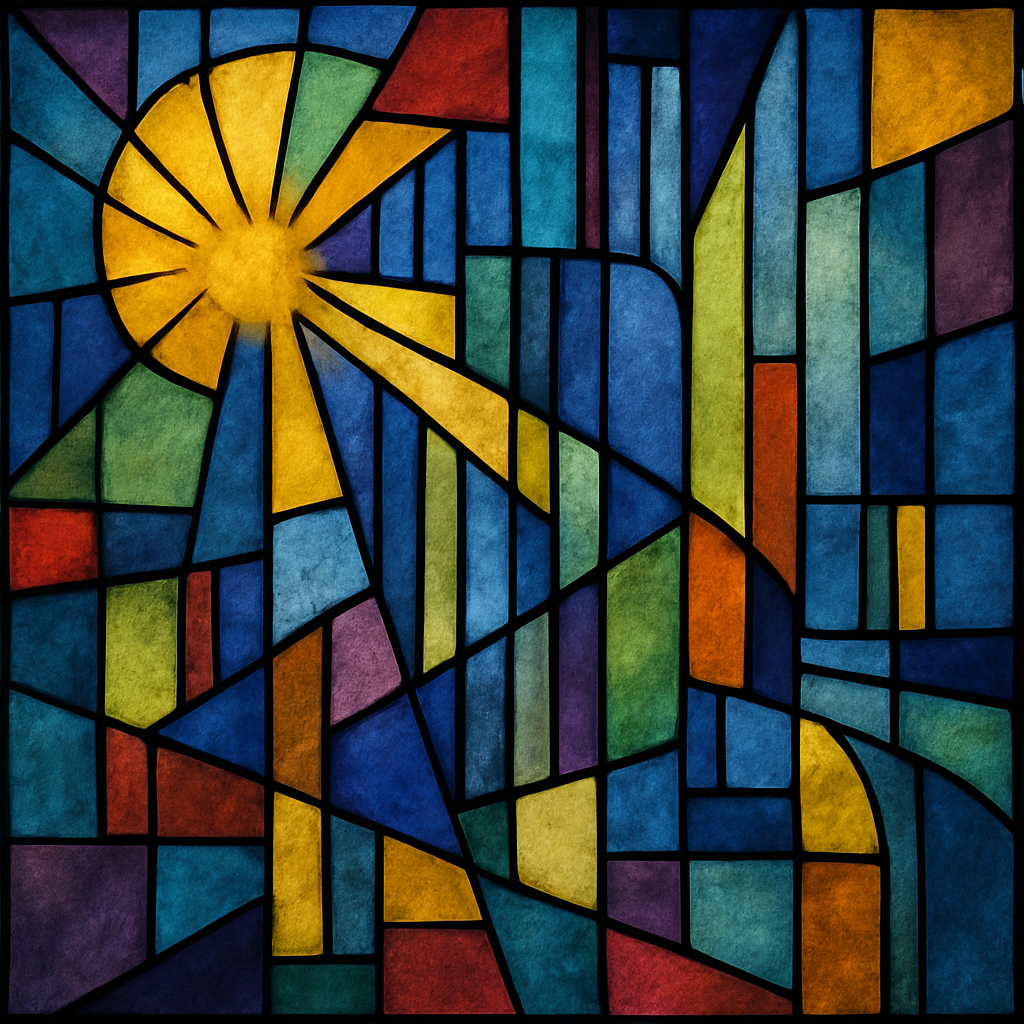
The work does not follow a linear development, but is built instead from a succession of fragments, each with its own breath, much like church stained-glass windows traversed by an ever-changing light. Each section functions as an autonomous apparition, a shard of light, a self-sufficient timbral and gestural configuration, linked to the others not by narrative but by affinities of resonance and color. Throughout this auditory montage, suggestions of sacredness hover persistently, culminating in the iridescent echoes of the ancient Christian hymn Φῶς ἱλαρόν, Phōs hilarón, Joyful Light, still sung today at Orthodox Vespers, a final sonic fulguration before silence.
The form of the piece is in principle free. The music is built more from gestures and breaths than from musical substance proper, almost like a sketch for a possible music not yet fully materialized.
And yet one may still speak of a musical dramaturgy, in the sense that the piece displays a kind of discourse in which the type of musical syntax employed itself marks off the form, which is why the texture types used are so deliberately raw, overt, and unambiguous.
There is also a general process of coagulation of the sonic material, which helps make the opus intelligible as a whole. For despite its manifest heterogeneity and fragmentation, the score does in fact crystallize around a single idea, a shared subtext: the search for harmony, in both the musical and the metaphysical sense, harmony as the supreme mode of justification and fulfillment in communion rather than in individuality. Concretely, the piece evolves, non-linearly — owing to its multiple insertions, many of them strongly chamber-like — from a multicolored babble, more or less dissonant and agitated, in which the instruments are sharply individualized, something that recalls the golden age of certain long-vanished avant-garde musics — a pointillism lacking meanings of its own or any great depth, though not necessarily devoid of wit — toward more homophonic, consonant, and idiomatic writings rooted in late Classicism or early Romanticism, in which the instruments seem to discover a higher meaning through cooperation and through their relation to one another.
Given its extreme heterogeneity, the harmonic substance of the piece is difficult to classify. In the last analysis, it is a panoply of stylistic and geographic wanderings that bring together, for instance, Wagnerian harmonies and orientalizing superpositions. One could probably find here most of the harmonic innovations of the last century: Bartók’s minor-major chord, Messiaen’s added-note chords, fourth- and fifth-based harmonies, Hindemith, Stravinsky, perhaps Copland, polychords, perhaps Charles Ives, and so forth, all of it culminating, toward the end, in a bewildering ocean of consonance, disarmingly naive, pure, and luminous, perhaps in the manner of Arvo Pärt, or rather John Tavener, given the Byzantine-inspired melodic material I employ.
As for the horizontal, intonational, diachronic plane, the music lives to a large extent from a deconstruction of the hymn just mentioned, whose primary melodic elements subtly and decoratively feed both the substance of the interstices between sections — more visibly — and the general melodic gesturality — more discreetly. This becomes clearly perceptible only after the fact, once that musical material is finally granted the right to its own life and unfolding, at which point the entire preceding latent process suddenly appears in full light.
On the rhythmic level, the piece relies on the perplexity produced by the combination of chaos — statistically predominant and obtained through arrhythmia, itself generated by an exacerbation of perpetual rhythmic invention — and oligorhythmia, used on smaller surfaces but highly conspicuous because it brings with it a strong ritual charge.
The orchestration might best be described as functional, in the sense that it faithfully supports and brings out the intended melodic gesture and harmonic color. It is worth noting that the organ, a pipe organ, a church organ, does not explicitly occupy a soloistic role within the ensemble, though neither does it refuse such a posture when occasion arises; it is employed here above all to offer an alternative timbral universe, being itself a kind of second orchestra.
Fúlgura is the plural form of the Latin noun fulgur, "lightning", or "flash of light". It seemed to me that such a title, implying at once concision, energy, and sacredness, serves this strange musical assemblage particularly well: a handful of musical shards hurled into the ether by flashes of the spirit, a hollow of sonic matter seeking its way toward a higher calling.