A farmer went out
Eclectic modalism with cinematic drive
Scores & Recordings
 Download score (PDF)
 Download recording (MP3)
Recording
Summary
A farmer went out is an eclectic work that combines Byzantine-derived melodic thinking with polytonality, polymodality, and a pronounced cinematic impulse. Drawing on the Parable of the Sower, the piece moves between scholastic, chant-inflected discourse and the charged idiom of psychological thriller or adventure-film music.
Imprint
| Orchestration | orchestra, amplified baritone voice and small organ |
|---|---|
| Lyrics | Sacred text, Marc 4:3-9 |
| Duration | 19:07′ |
| State | Finished |
| Completed | 2022 |
| Premiered | — |
| Performed by | — |
| Honors | Acquired by UCMR in the November 2022 session |
| Copyright | Claudius Iacob |
Program notes
A farmer went out is an essentially eclectic work, combining in a deliberate and fully assumed manner a significant number of writing idioms, pitch-organization systems, and musical syntaxes.
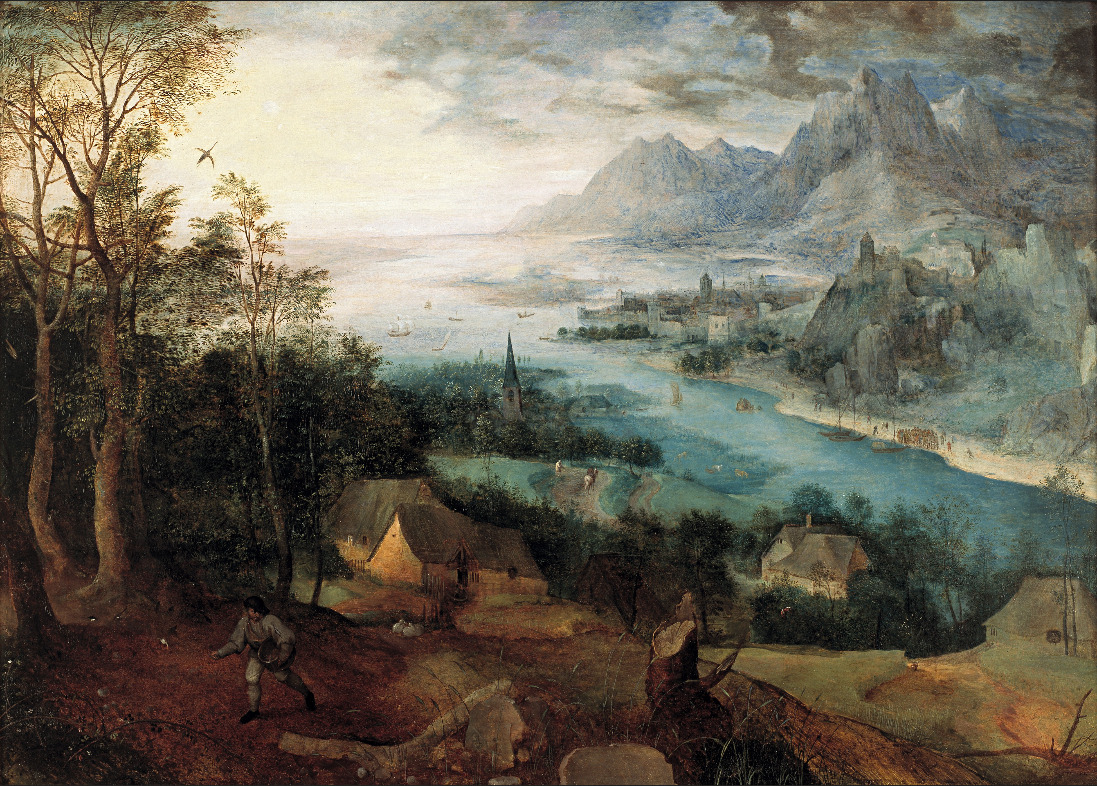
Taking advantage of the unique combination of the sacred and the dramaturgical offered by the chosen scriptural text as its support, the Parable of the Sower in Saint Mark’s version, Mk. 4:3-8, my piece experiments with a personal version of a Byzantine melodic idiom, clothed harmonically in a blend of polytonality and polymodality. It combines this, in an unusual manner, with a cinematic breath, something I had already attempted in other works, most notably Ici Bas in 2017. Thus the score oscillates, without losing its equilibrium, between a scholastic discourse made up of short, explicitly articulated, sententiously assertive phrases and an idiomatic writing proper to the psychological thriller or the adventure film.
The music is therefore built heterogeneously, alternating moments of fragmented, discontinuous discourse with homogeneous surfaces of thematic working, and alternating the dense heterophony required by the modal material of Byzantine origin with the lighter homophony specific to orchestral figurations familiar from film music.
The harmony is based on a mixture of pitch-organization systems, ranging from polymodality and polytonality — which predominate and are used ostentatiously in many places, to the point that two or more different gravitational centers are explicitly and simultaneously assigned to two or more instrumental families or groups — to free atonalism and twelve-tone serialism, see in this regard the fugue in the second section.
The melodic substance — where it is not gestural in a rhetorical, Baroque spirit — is irreducibly derived from two plagal Byzantine modes: echoi V, diatonic, chosen for its specific formulaic behavior around its mutable sixth degree, and echoi VI, chromatic, chosen for its color and for the Phrygian cadence it offers on the level of both of its symmetrical tetrachords.
The rhythm varies across a very broad spectrum, from monorhythm, see the march in the opening and penultimate section, to perpetual rhythmic invention, in fact a species of arrhythmia, see the woodwind heterophonies in the final section.
Formally, the piece is kaleidoscopic, revealing itself to the listener in small autonomous units of content, strongly individualized by orchestral color and by writing. The orchestration is therefore based on the isolated treatment of instrumental families and groups, with moments of true timbral blending remaining quite rare.
Last but not least, it should be mentioned that the musical text in fact supports a literary text in absentia, more precisely verses 14-20 of the same chapter, in which Jesus interprets the parable privately to His disciples. Seen from this perspective, the drama and apodictic character of the middle sections acquire an altogether different meaning, as does the rich rhetorical apparatus behind the musical gestures so abundantly present in the melodic writing. I will not elaborate on this point, leaving such a possible analysis to the musicologist interested in formulaic writing and Affektenlehre.